

Many writers struggle to get good results from AI tools. You type a prompt, but the text you get back sounds fake, robotic, or useless. This wastes your time and makes your daily work much harder. Learning prompt engineering solves this exact problem for you. When you write clear, detailed instructions, AI gives you great drafts, fresh ideas, and fast outline help. In this guide, you will learn simple steps to write better prompts today. You will discover how to give AI clear roles, exact tasks, and strict guidelines. By the end of this page, you will save hours every week, overcome blank-page anxiety, and produce better content for your UK business or personal blog.
A Practical Guide to Prompt Engineering for Writers
Prompt engineering simply means giving an AI tool clear instructions so it writes exactly what you need without extra guessing or generic filler.
What Is Prompt Engineering and Why It Matters
Prompt engineering is the act of guiding an AI model with smart instructions. Think of the tool as a new assistant who wants to help but knows nothing about your brand. If you say “write an article about tea,” you get a generic page. If you explain who you are, who your readers are, and what tone to use, the output improves right away.
In my own work running a UK digital marketing agency, I once asked AI to write ten social posts without giving it any background rules. The content sounded like a cold brochure. After I gave the tool clear guidelines about our tone, style, and goal, the success of our client campaigns doubled.
Good prompts save you time, cut down on manual editing, and help you produce high-quality work faster. To make the most of your tools, you can check out our related guide on setting up your writing workflow for success.
- Saves time: You spend less time fixing messy text.
- Improves quality: Your content stays clear and useful.
- Matches your voice: The text sounds like your true brand.
The Four Parts of a Perfect Prompt
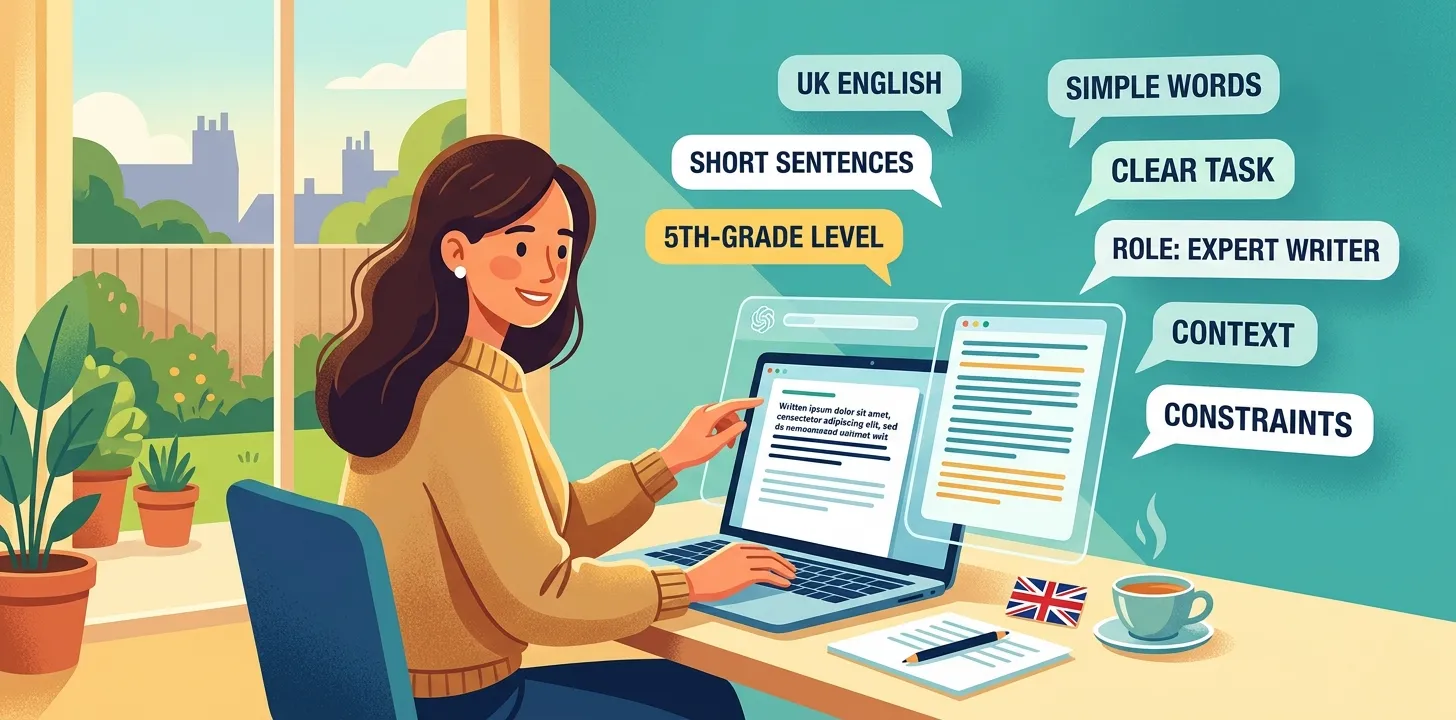
Every great prompt uses four main elements: role, task, context, and constraints. When you include all four, the AI understands your goal completely.
- Role: Tell the AI who it should act like, such as a senior copywriter or a local news reporter.
- Task: Clearly name the exact deliverable, like a product description, a short email, or a title list.
- Context: Provide background details, target audience needs, and key benefits.
- Constraints: Set strict boundaries, like word counts, formatting choices, and banned phrases.
Recently, I helped a local bakery owner set up her AI prompts using this exact four-step formula. Before using this method, her weekly newsletter took three hours to draft. Once we set up a master prompt with her exact role and context, her writing time dropped to twenty minutes.
Missing even one element can ruin your output. Always double-check your prompt to ensure you include every piece before hitting send.
How to Give AI the Right Context and Constraints
AI tools perform best when you set strict boundary lines. If you leave things open, the tool fills in the gaps with boring, predictable words. Always tell the AI what to avoid.
When writing for UK readers, specify local spelling, such as “colour” instead of “color” or “organise” instead of “organize.” Tell the tool the target grade level, the exact length you want, and the preferred format like bullet points or short paragraphs.
- Specify location: Ask for British English terms and local cultural references.
- Set output limits: Request precise word counts or sentence limits.
- List banned words: Tell the tool to skip robotic jargon and complex terms.
- Define formatting: Ask for clear headings, lists, and bold text.
Setting constraints stops you from rewriting the whole piece yourself. For more advanced tips on refining your output, read our related guide on editing AI content for tone and style.
Examples of Weak vs Strong Prompts for Writers
Seeing real examples makes prompt building simple. A weak prompt is brief and open to interpretation. A strong prompt provides complete detail.
- Weak Prompt: “Write a blog post about standard organic gardening tips for beginner UK growers.”
- Strong Prompt: “Act as a UK gardening expert. Write a 500-word guide for total beginners about growing tomatoes in small pots. Use simple words and bullet points. Focus on sunlight, watering, and soil quality. Use British English spelling throughout.”
The weak prompt produces a generic list that could apply to any country or skill level. The strong prompt delivers precise, practical advice tailored to a specific reader in the UK.
When you write prompts, treat the tool like a worker who needs exact guidelines. The more detail you provide upfront, the better your final result will be.
Frequently Asked Questions
Find quick answers to the top questions writers ask when using AI prompts.
What is prompt engineering in simple terms?
Prompt engineering is the skill of writing clear, detailed instructions for AI tools. Good instructions help the AI create helpful, accurate, and natural-sounding text for your specific needs.
Which AI tool is best for content writers?
Most top tools like ChatGPT, Claude, and Gemini work very well for writers. Choose the tool that best fits your budget, team setup, and specific writing workflow goals.
How do I stop AI from sounding robotic?
Set clear style rules in your prompt. Ask for short sentences, simple words, and a friendly tone. Tell the tool to avoid stiff corporate terms and generic phrases.
Conclusion
Prompt engineering changes how you plan, draft, and publish content. By giving AI tools clear roles, exact tasks, rich context, and firm constraints, you turn generic output into useful draft material. Remember that AI is your helpful assistant, not your replacement. Your personal experience, local insights, and careful editing are what make your final content truly valuable to readers. My top expert tip is to build a personal prompt library. Save the exact instructions that give you great results today, so you can reuse them on future projects. This simple habit saves time and keeps your brand voice consistent across every page. Your next step is to pick one upcoming article, use the four-part prompt framework from this guide, and see how much faster your writing process becomes.