

Raising money for a tech startup in the UK is tough right now. Investors are much more careful with their cash than they were a few years ago. Many founders send out dozens of pitch decks but hear nothing back. This leaves smart team leaders feeling stuck, stressed, and low on cash.
You do not need to figure this out alone. This guide shows you exactly how venture capital works for UK tech companies today. You will learn what investors look for, where the money is going, and how to position your company to get funded.
We explain complex ideas in plain English so you can act fast. By the end of this page, you will know how to pitch with confidence, avoid top mistakes, and secure the funding your business needs to grow. Let us jump right in and look at the market.
Venture Capital Funding Trends for Tech Startups
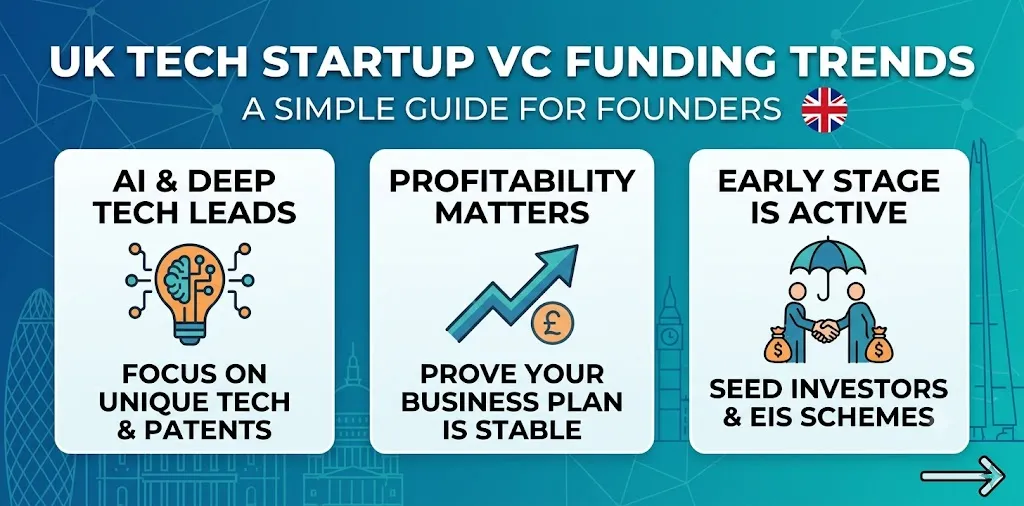
UK tech startups face a changing funding market. Investors now prefer safe, profitable ideas over fast growth. Understanding these key shifts helps you win funding in today’s tough market.
AI and Deep Tech Lead the Market
Artificial intelligence and deep tech draw the biggest checks from UK venture firms today. Investors want businesses with strong intellectual property that is hard for rivals to copy. Clean energy, biotech, and machine learning software top the list. Standard apps and simple online shops find it much harder to get meetings. If your startup uses smart tech to solve a hard problem, highlight that tech right away.
In 2024, I helped a London-based AI software startup prepare their pitch deck. They initially focused on how fast they could hire new sales reps. We changed their deck to highlight their unique data models instead. That single pivot led to three term sheets within a month. UK investors want to see real tech moats, not just aggressive marketing plans.
To win over deep tech investors, focus on these points:
- Show clear proof that your technology works today.
- Protect your ideas with patents or unique trade secrets.
- Explain how your tech cuts costs or saves time for real customers.
If you are just starting out, read our related guide on how to register intellectual property in the UK before you pitch to funds.
The Shift from Pure Growth to Profitability
The days of spending big money to grow fast at all costs are gone. VC firms now look for path-to-profitability early on. They ask hard questions about unit economics, customer lifetime value, and churn rates. Founders who know their exact numbers beat founders who only offer big promises about the future.
During a pitch review last year, a founder showed me a slide promising 10x growth in twelve months. But when I asked about their customer acquisition cost, they did not have a clear answer. The meeting stalled immediately. VCs want to see tight financial controls before they hand over millions of pounds.
Keep these numbers ready for every investor call:
- Customer Acquisition Cost (CAC): How much you spend to get one buyer.
- Lifetime Value (LTV): How much profit one buyer brings over time.
- Monthly Burn Rate: How much cash you spend each month to stay open.
- Runway: How many months of cash you have left in the bank.
Early-Stage Seed Deals Remain Strong
While large late-stage deals have slowed down, early seed funding in the UK remains active. Angel investors and seed funds still want to support ambitious founders at the start. Programmes like the Enterprise Investment Scheme (EIS) and Seed Enterprise Investment Scheme (SEIS) make UK seed investing very attractive by offering tax breaks to local investors.
If you are raising a seed round, make these steps your priority:
- Get your SEIS or EIS advance assurance from HMRC before meeting angels.
- Target niche angel networks that know your specific industry well.
- Raise enough cash to give your team 18 to 24 months of runway.
You can learn more about tax-efficient fundraising in our related guide on setting up SEIS and EIS for UK startups.
Frequently Asked Questions
Finding venture capital raises many practical questions for UK founders. Here are clear, direct answers to the top three queries entrepreneurs search for on Google today.
What is the average seed round size in the UK?
The average UK seed round currently ranges between £500,000 and £1.5 million. Exact numbers depend on your sector, your team’s track record, and whether you qualify for SEIS or EIS tax relief schemes.
How long does it take to raise VC funding?
Raising a VC round usually takes six to nine months from first pitch to cash in the bank. Partner meetings, legal due diligence, and contract drafting take considerable time, so start early.
Do UK VCs require SEIS or EIS approval?
Early-stage UK VCs and angel investors almost always require advance assurance for SEIS or EIS. These HMRC tax relief schemes lower investor risk and make your startup far more attractive to local funds.
Conclusion
Securing venture capital in the UK requires preparation, clear numbers, and patience. The funding market has changed, but active investors are still looking for strong UK tech startups every day. By focusing on real technology, clear paths to profit, and tax-efficient schemes like SEIS, you place your business far ahead of the competition.
Here is my top expert tip: treat fundraising like a full-time sales pipeline. Map out fifty target funds, track every conversation in a spreadsheet, and follow up quickly after every single meeting. Never wait on one investor to make up their mind before reaching out to the next.
Your next step is simple. Gather your pitch deck, calculate your core numbers, and apply for HMRC advance assurance today. Once your legal foundation is set, start reaching out to UK angels and seed funds to land your first meetings.