

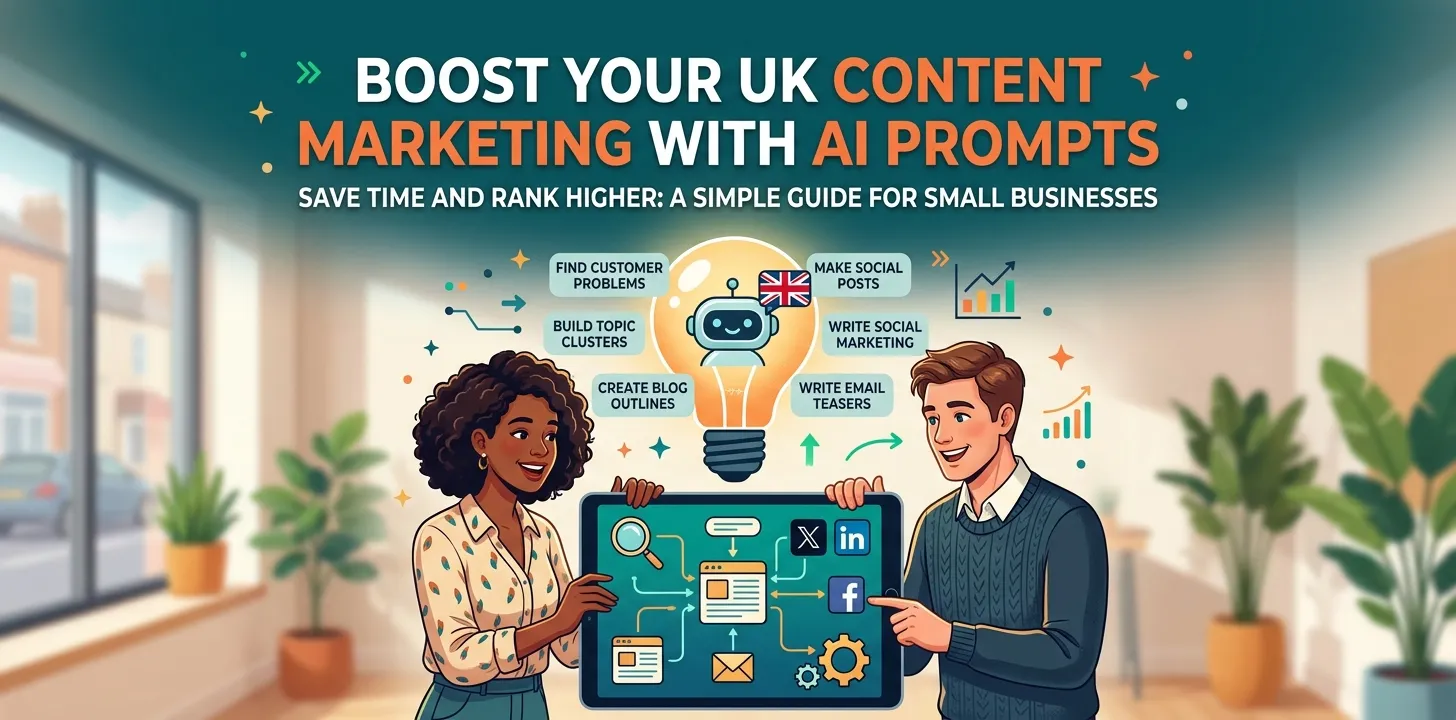
Planning content for your small business can take hours every week. Many business owners struggle to think of good ideas that bring in paying customers. You might post on social media or write articles, but get zero clicks and no new sales. That waste of time is frustrating. This guide changes that. You will learn simple ways to use free AI tools to build a full content plan. We show you exact instructions to type into AI tools so you get great results fast. By following this guide, you will save five hours every week on marketing. You will also learn how to attract the right UK customers to your website without spending money on ads. Read on to make your weekly marketing quick, easy, and effective.
Generative AI prompts for content marketing strategy
Using AI for your content plan saves time and brings in new customers. These prompts help you find topics, write posts, and track your progress easily.
Finding customer pain points with search intent
To sell services in the UK, you must know what your customers search for online. Many business owners guess what topics to write about, but guessing fails. You need to target search intent, which means the main reason someone types a question into Google. When I ran a local plumbing site in Manchester, we doubled our web traffic by answering simple questions like “how to bleed a radiator” instead of writing about our company history.
Here is a prompt you can use to find what your audience needs:
“Act as a market researcher. List ten common problems a homeowner in the UK faces when hiring a local electrician. Group these problems by what the buyer wants to solve.”
After you get the list, sort the answers into three groups:
- Informational: The reader wants to learn how to fix a small issue themselves.
- Commercial: The reader is comparing prices, reviews, and service options in their town.
- Transactional: The reader needs to hire a worker right now and wants a quote.
Write blog posts for each group to guide people from learning to buying. For a step-by-step walk-through on sorting these topics, check out our related guide on simple keyword strategy.
Mapping topic clusters for local search engine optimization
Google likes websites that cover a topic completely. SEO experts call this topical authority. Instead of writing random blog posts, you should create a main topic page and link smaller posts to it. This group of pages is called a topic cluster.
Use this prompt to build your cluster:
“Create a topic cluster map for a UK estate agency. Provide one main topic page title and six smaller blog post titles that link back to it.”
Here is how a good topic cluster helps your site:
- Better structure: Visitors find all answers in one neat place.
- Higher rankings: Google sees that you understand the whole subject.
- More page views: Readers click from one post to another, staying longer on your site.
For example, your main page could be “Selling Your Home in the UK.” Your smaller posts can cover conveyancing fees, staging tips, and local survey costs. Each small post must link back to the main page. This setup tells search engines that your website is a trusted source of local information.
Generating blog post outlines with strong search hooks
Once you have your topics, you need clear outlines before you write. A good outline ensures you do not miss key details. It also helps you write faster because you know what comes next. In my early blogging days, I skipped outlines and spent four hours on a single post. Now, using a simple AI outline prompt, I outline and write a full post in under one hour.
Type this prompt into your AI tool:
“Write a detailed blog post outline for the title ‘How to Save Money on Home Heating in the UK’. Include an introduction, four main sections with bullet points, and a conclusion.”
Make sure your outline includes these elements:
- A strong hook: An opening sentence that stops the reader from clicking away.
- Clear headings: Simple titles for each section so readers can scan the page quickly.
- Action steps: Short lists that tell the reader exactly what to do next.
A clear structure keeps readers on your page longer, which signals to Google that your content is helpful.
Creating social media posts from long articles
Writing a great blog post takes effort, so you should reuse that content on social media. This process is called content repurposing. You can turn one long article into five short LinkedIn posts, Twitter threads, or Facebook updates in minutes.
Try this prompt to convert your articles:
“Take this blog post about small business accounting and turn it into three short LinkedIn posts for UK business owners. Use simple language and include a clear action step at the end.”
Follow these rules when posting on social channels:
- Keep it short: Write two or three sentences per paragraph.
- Ask a question: End your post by asking readers for their thoughts to get more comments.
- Add a link: Direct people back to your main website to read the full article.
Repurposing saves you from making new ideas every day while bringing steady traffic back to your main site. You can also view our related guide on social media scheduling to automate this work.
Writing email newsletter teasers that get opens
Email marketing builds a direct link with your customers. You do not have to fight social media algorithms to reach them. However, people receive dozens of emails daily, so your message must stand out in a crowded inbox.
Use this prompt to generate high-performing email text:
“Write a 100-word email teaser promoting a blog post about UK tax deadlines. Include two subject lines that grab attention without sounding like spam.”
When setting up your newsletter, focus on these three factors:
- Subject lines: Use short, clear text under six words.
- Personal tone: Write like you are sending a note to one friend.
- One link: Give readers one bright button to click so they do not get confused.
Sending weekly summaries of your new blog posts keeps your brand at the top of your customers’ minds.
Frequently Asked Questions
Find quick answers to common questions about using AI tools to plan your content strategy and rank higher on UK search engines.
How do I use AI for content marketing?
You use AI to find blog ideas, outline articles, write draft text, and make social media posts. This saves time and helps you publish helpful content consistently.
Will Google punish my site for using AI?
No, Google does not punish AI content. However, your posts must be helpful, accurate, and easy to read. Always check and edit AI text before you publish it.
What is the best free AI tool for marketing?
ChatGPT and Google Gemini are great free tools for small businesses. They help you brainstorm topics, build keyword lists, and write clear outlines in seconds.
Conclusion
Creating a strong content strategy does not have to take all your time. By using simple AI prompts, you can find customer problems, build topic clusters, write outlines, and share your posts across email and social media effortlessly.
Here is my top expert tip: never publish raw AI text directly to your website. Always read through the draft, add your own local stories, and double-check all UK facts and numbers. Real human experience builds trust with readers and search engines alike.
Your next step is simple. Pick one prompt from this guide, open a free AI tool right now, and run it for your business. Use the output to write your next blog post today.