NVIDIA Stock Surges 33% After Jensen Huang Returns as CEO: Inside Wall Street’s $1 Trillion Reversal
I stared at my brokerage screen on Monday morning, November 23, 2026, convinced the price feed had glitched. Friday had closed with NVIDIA bleeding out at $125.53, bruised by scandal and federal probes. By the opening bell, the ticker was tearing past $165 like a rocket that had just remembered which way gravity works.
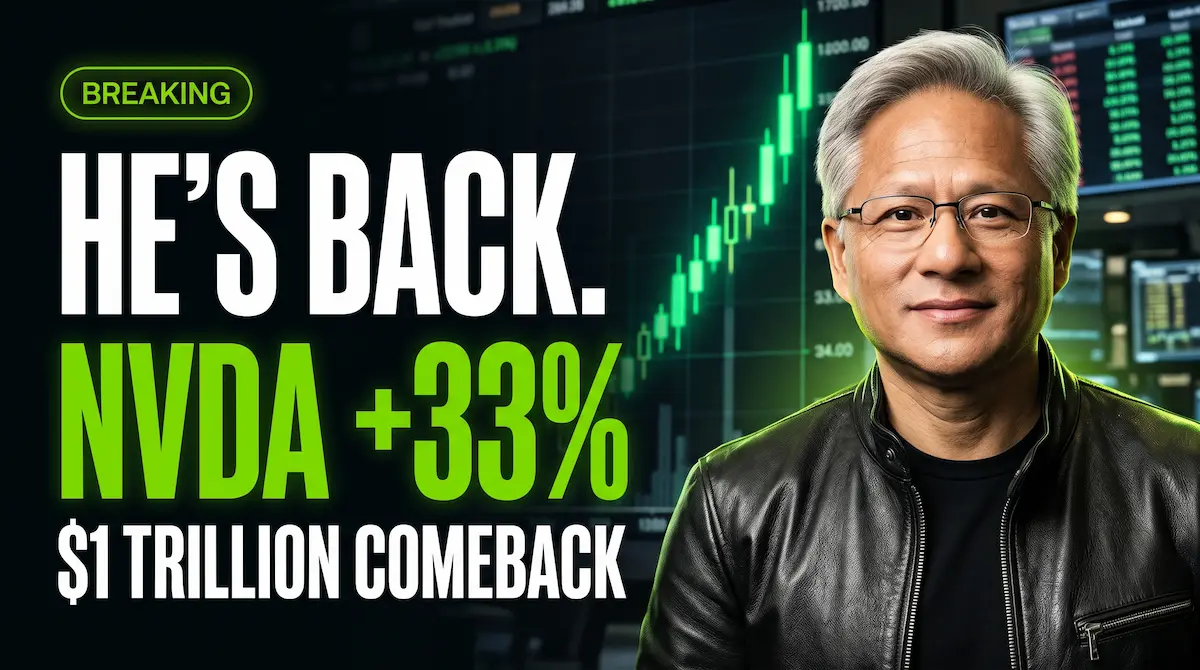
NVIDIA Stock Surges 33% After Jensen Huang Returns as CEO, adding more than $1 trillion in market value in a single New York session. Just eleven days after resigning amid a messy personal and national security controversy, the leather-jacketed co-founder is back in the corner office.
How does a multi-trillion-dollar corporate board tell investors “no” on a Tuesday and unanimously reverse itself the following Monday? Stick with me here. We are going to unpack the wild 11-day timeline, the $12.2 billion wipeout for short sellers, the federal investigations that haven’t vanished, and what this chaos actually means for your portfolio and the next generation of gaming GPUs.
[Image Suggestion: Dramatic editorial photo of a glowing green NVIDIA stock chart surging upward beside a silhouette of a tech executive in a black leather jacket on a Wall Street trading floor | Alt Text: NVIDIA Stock Surges 33% After Jensen Huang Returns as CEO on November 23, 2026]
Why Did NVIDIA Stock Jump 33% on November 23, 2026?
NVIDIA stock jumped roughly 33% intraday on November 23, 2026, because NVIDIA’s Board of Directors unanimously reinstated co-founder Jensen Huang as President, CEO, and Board Director effective immediately. That surprise U-turn erased nearly two weeks of panic selling, reignited the broader AI chip sector, and restored Wall Street’s confidence in NVIDIA’s product roadmap.
Honestly, I have followed hardware companies since the days when enthusiasts argued over SLI bridges in dusty forum threads, and I have never seen a stock react like this to a single person. On Friday, November 20, shares had tumbled 14.01% to close at $125.53 following reports of an SEC accounting inquiry. Then came Monday’s press release.
Premarket quotes shot up more than 25% past $162 before regular trading even started. Once the bell rang, NVDA climbed as high as $167.14 to $168.50 intraday, briefly flirting with a 35% surge before cooling off near $164.38. Even so, adding over a trillion dollars of market capitalization before lunch is the kind of market move financial historians will still dissect in 2040.
Meanwhile, the shockwave didn’t stay confined to Santa Clara. The Nasdaq Composite roared higher by 6% to 7% as the AI trade snapped back to life. Taiwan Semiconductor Manufacturing Company (TSMC) saw its ADR climb 6%, while AMD, Broadcom, Micron, and even Bitcoin rallied in sympathy.
What Actually Happened During the 11-Day NVIDIA Crisis?
To understand why Monday’s bounce felt so explosive, you have to look at how fast the floor fell out under NVIDIA earlier this month. Most casual readers saw a headline about a scandal and assumed it was standard Silicon Valley gossip. In reality, it combined corporate governance drama with high-stakes geopolitical tension.
On November 8, 2026, Huang acknowledged extramarital affairs after investigative reporting exposed his personal ties. One relationship involved a direct subordinate at the company. Another involved Alice Huang (no relation), a former executive at Megaspeed, a Singapore-based cloud firm and major NVIDIA chip buyer.
Here is where the story took a sharp turn into thriller territory. U.S. intelligence officials reportedly suspected Alice Huang of ties to Chinese intelligence, an accusation Beijing flatly denied. Because Megaspeed was already under scrutiny over potential chip-smuggling violations, the optics looked terrible for America’s most important semiconductor company.
The Resignation and the Six-Day Standoff
Four days later, on November 12, NVIDIA announced Huang’s immediate resignation. Longtime CFO Colette Kress stepped in as interim CEO, and Harvey C. Jones became the company’s first formal Chair of the Board. The stock dropped 4.34% to $166.19 that day, which felt almost polite compared to the bleed that followed.
On Tuesday, November 17, Kress ran her first quarterly earnings call for Q3 fiscal 2027 without Huang. Around that same time, Huang posted online that he would feel honored to return if asked. Chair Harvey C. Jones poured cold water on that idea right away, telling analysts the board had no intention of reinstating him.
That firm refusal lasted exactly six days. By Friday, November 20, news of an SEC probe into NVIDIA’s accounting and disclosures sent shares plunging 14% to $125.53. Suddenly, the board’s principled stand was colliding head-on with a full-blown market meltdown.
Why Did the NVIDIA Board Reverse Course So Quickly?
You might be wondering what convinced a cautious corporate board to eat crow in less than a week. After digging through the official filings and White House statements, I believe three forces squeezed the directors simultaneously: direct White House pressure, a massive Silicon Valley rebellion, and raw stock-market fear.
First, President Donald Trump stepped directly into the ring. In an interview with CNBC and a post on Truth Social, Trump stated that he had spoken to the board directly and indirectly, insisted Huang did “nothing wrong,” and declared that the U.S. government had no reason to believe Huang’s return posed a national security threat. NVIDIA’s own reinstatement statement explicitly pointed to “input from senior levels of the United States government”.
Second, Silicon Valley refused to sit quietly. Within days of Huang’s November 12 exit, an online petition demanding his return collected more than 180,000 signatures from current employees, former staffers, and tech heavyweights, including Elon Musk. Even international leaders chimed in afterward, with Israeli Prime Minister Benjamin Netanyahu welcoming Huang’s return for the sake of global AI continuity.
Third, the board simply looked at the scoreboard. Between its October 6 peak of $239.24 and Friday’s $125.53 close, NVIDIA had lost nearly half its value. Keeping Huang out was starting to look far riskier to shareholders than bringing him back.
[Internal Link: How NVIDIA’s AI Chip Dominance Reshaped Global Tech Markets in 2026]
The $12.2 Billion Short-Seller Wipeout and Huang’s Wealth Bounce
Whenever a megacap stock jumps 33% in a single morning, somebody on the other side of the trade is having a very bad day. On Monday, that somebody was Wall Street’s short sellers.
According to financial analytics firm ORTEX, investors betting against NVIDIA took roughly $12.2 billion in mark-to-market paper losses in one session. That marks their worst single-day beating since at least 2019, instantly erasing more than $10.5 billion in profits they had just booked the week before. Still, before you feel too sorry for the bears, ORTEX noted that short sellers remained up about $14 billion on paper since October 29.
Here is a technical detail that many quick-hit news blogs missed. Was this a classic meme-stock short squeeze? Probably not. ORTEX co-founder Peter Hillerberg pointed out that short interest sat at just over 1% of shares outstanding, meaning the 33% rocket ride came from genuine institutional buying rather than panicked short covering.
On the winning side of the ledger sat Jensen Huang himself. Because he holds an estimated 3.5% stake in the company he co-founded in 1993, Monday’s rally added roughly $36.6 billion to his personal net worth in a matter of hours. That rebound lifted him back to 13th on Forbes’ global wealth list at around $143.4 billion.
Timeline and Price Breakdown: 11 Days That Shook Wall Street
When I track fast-moving market stories, I like putting the raw dates and numbers side by side so the narrative noise fades away. Notice how NVIDIA’s share price didn’t just react to the scandal itself; it reacted to the uncertainty of life without its founder.
| Date (2026) | Key Event | NVDA Price / Impact |
| Oct 6 | Pre-scandal peak before autumn sell-off | $239.24 closing high |
| Nov 8 | Huang admits to extramarital affairs | Board opens probe |
| Nov 11 | Last close before CEO exit news | $173.73 close |
| Nov 12 | Huang resigns; Colette Kress named interim CEO | $166.19 (-4.34%) |
| Nov 17 | Q3 FY27 earnings; Chair rules out return | ~$155 trading level |
| Nov 20 | Reports of SEC accounting probe hit | $125.53 (-14.01%) |
| Nov 23 | Board unanimously reinstates Huang | ~$167 intraday (+33%) |
Look closely at that top row and that bottom row. Even after the headline-grabbing 33% surge, NVIDIA stock is still sitting roughly 30% below its October 6 closing high of $239.24. The rally brought the stock right back to where it stood on November 12, the day Huang resigned, which tells you Wall Street priced out the leadership vacuum, yet kept a hefty discount for the legal clouds hanging overhead.
[Image Suggestion: Clean, minimalist financial timeline infographic showing NVIDIA’s share price drop from $239.24 on Oct 6 to $125.53 on Nov 20 and vertical rebound to $167 on Nov 23 | Alt Text: Timeline of NVIDIA stock jumps 33% Jensen Huang Returns rally in November 2026]
Haven’t We Seen This Movie Before? The Sam Altman Parallel
If this whole saga gave you intense déjà vu, you are not alone. Almost exactly three years ago, in November 2023, OpenAI’s board ousted co-founder Sam Altman over candor concerns, only to watch employees revolt and reinstate him within days.
Now we have watched the exact same script play out at a publicly traded semiconductor giant, just with bigger dollar signs and White House phone calls. Here is how Silicon Valley’s two most famous CEO boomerangs stack up.
| Feature | Jensen Huang (NVIDIA, 2026) | Sam Altman (OpenAI, 2023) |
| Time Away | 11 days (Nov 12 to Nov 23) | 5 days (Nov 17 to Nov 22) |
| Trigger | Extramarital affairs and Megaspeed ties | Board dispute over candor |
| Key Catalyst | White House input, 180k petition, stock crash | Staff open letter and Microsoft pressure |
There is a blunt lesson buried in this comparison, and I think investors ignore it at their own peril. Modern AI companies are dangerously dependent on founder mythology. When a single executive’s presence is worth $1 trillion on a Monday morning, that company does not have a deep succession bench; it has a single point of failure.
What Does Jensen Huang’s Return Mean for Tech Fans and Gamers?
At MediaOneStop, we care just as much about the hardware sitting inside your PC case as the ticker scrolling across CNBC. So let’s ask a practical question: if you are a gamer or PC builder eyeing your next GeForce upgrade, should you care about this boardroom soap opera?
Yes, actually, for two concrete reasons. First, Colette Kress is a rock-solid financial operator who now returns to her CFO seat, yet Huang is the product architect who drives NVIDIA’s aggressive cadence across data center silicon and consumer graphics cards. A prolonged, messy CEO search could have stalled supply-chain negotiations with TSMC and delayed consumer GPU allocations while executives scrambled to defend their turf.
Second, stability at the top keeps NVIDIA’s software ecosystem moving forward. When leadership gets distracted by survival mode, driver teams and developer partnerships are usually the first to feel the friction. With Huang back at the wheel, NVIDIA’s engineering teams can get back to shipping silicon instead of refreshing news feeds.
[Internal Link: Best Gaming GPUs to Buy Right Now: Performance and Value Guide]
The Risks Wall Street Is Ignoring Right Now
I am going to take a clear stand here: celebrating Monday’s 33% surge as “problem solved” is wishful thinking. Bringing Jensen Huang back fixed NVIDIA’s leadership crisis, yet it did not erase a single legal subpoena.
Before anyone rushes to chase this rally, look at the four unresolved hazards still sitting on NVIDIA’s desk:
- Active DOJ Criminal Probe: The U.S. Department of Justice is investigating Megaspeed over potential export-control violations tied to whether restricted AI chips reached China. Even though President Trump said Attorney General Todd Blanche felt Huang was exonerated, criminal export probes can still snare corporate partners and disrupt international sales.
- SEC Accounting and Disclosure Inquiry: The Securities and Exchange Commission opened a civil investigation examining NVIDIA’s accounting practices and investor disclosures. Remember, that report alone shaved 14% off the stock on Friday, November 20, and SEC reviews rarely wrap up overnight.
- Bipartisan Congressional Pushback: Lawmakers on Capitol Hill are not backing down. Senator Elizabeth Warren posted on X that the board’s decision “does not change the fact that Huang and NVIDIA still owe Congress answers”, and Huang is still staring down scheduled congressional testimony on December 1, 2026.
- Corporate Governance Damage: When a board says “we do not intend to reinstate him” on Tuesday and unanimously reverses course on Monday after political pressure, institutional investors notice. Shareholder lawsuits have already started piling up, and directors now face tough questions about their independence.
Common Mistakes Retail Investors Make After a 33% Spike
When I started investing years ago, I fell for the exact trap that catches thousands of traders on days like Monday. You see a massive green candle, feel a jolt of FOMO, and buy at the intraday peak right before early buyers take profits.
Here are the traps you must avoid this week:
- Chasing Opening-Day Momentum: Stocks that gap up 30% on headline news frequently retest lower support levels within days as short-term traders cash out.
- Confusing Political Support With Legal Immunity: A supportive Truth Social post moves markets in seconds, yet it does not stop congressional hearings or civil shareholder litigation.
- Ignoring Key-Person Risk: If NVIDIA loses $40+ per share whenever Huang steps away, your position sizing should reflect that volatility.
[Image Suggestion: Editorial illustration of a computer chip balanced on a tightrope between a Wall Street bull and the U.S. Capitol building | Alt Text: Risks facing NVIDIA after Jensen Huang returns as CEO amid SEC and Congressional probes]
My Verdict: What Should Investors and Readers Do Next?
Here is my honest take on where things stand after NVIDIA Stock Surges 33% After Jensen Huang Returns as CEO. Bringing Huang back was probably the only move that could stop the bleeding in the short term. NVIDIA’s customers, employees, and Wall Street analysts clearly view him as irreplaceable right now.
However, I would not buy a single share at the top of a 33% relief rally with a December 1 congressional hearing sitting one week away. That testimony could easily trigger another 10% swing in either direction depending on how aggressively lawmakers grill Huang over Megaspeed and internal disclosures.
If you already hold NVIDIA for the long haul, Monday’s rebound gives you breathing room to review your allocation calmly instead of panic-selling at $125. If you are looking to enter fresh, patience is your best edge. Wait for the post-rally volatility to settle, watch the December 1 hearing closely, and let the SEC disclosure picture come into sharper focus before putting new capital to work.
[Internal Link: How to Manage Portfolio Risk During High-Volatility Tech Earnings]
Frequently Asked Questions
Why did NVIDIA stock surge 33% on November 23, 2026?
NVIDIA stock jumped roughly 33% intraday on November 23, 2026, after the company’s Board of Directors unanimously voted to reinstate co-founder Jensen Huang as President, CEO, and Board Director. His return ended an 11-day leadership crisis that had pushed shares down to $125.53 the previous Friday.
Why did Jensen Huang resign from NVIDIA earlier in November 2026?
Jensen Huang resigned on November 12, 2026, following reports of extramarital affairs, including one with a direct subordinate and another with Alice Huang, a former executive at Singapore-based cloud firm Megaspeed. U.S. officials raised national security concerns over alleged Chinese intelligence ties, which Beijing denied.
Who ran NVIDIA while Jensen Huang was gone?
NVIDIA Executive Vice President and Chief Financial Officer Colette Kress served as interim CEO during Huang’s 11-day absence, including leading the company’s Q3 fiscal 2027 earnings call on November 17. Following Huang’s reinstatement on November 23, Kress returned to her full-time CFO role while Harvey C. Jones remained Board Chair.
How much did NVIDIA short sellers lose on Huang’s return?
According to financial analytics firm ORTEX, NVIDIA short sellers suffered an estimated $12.2 billion in mark-to-market paper losses on November 23, 2026. That represents their largest single-day loss since at least 2019, though ORTEX noted short sellers remained up roughly $14 billion on paper since October 29.
Are the SEC and DOJ investigations into NVIDIA over now?
No. While President Donald Trump said the U.S. government had no evidence of unlawful conduct by Huang, multiple inquiries remain active. The DOJ is investigating Megaspeed over potential export-control violations, the SEC is examining NVIDIA’s accounting and disclosures, and Huang still faces congressional scrutiny, including a December 1 hearing.
Is NVIDIA stock back to its all-time high after the 33% rally?
Not yet. Even after surging past $167 intraday on November 23, 2026, NVIDIA shares remained roughly 30% below their October 6, 2026 closing high of $239.24. The rally mainly recovered the ground lost after Huang’s November 12 resignation, while investors continue weighing ongoing regulatory risks.