

Choosing the right Artificial Intelligence (AI) tool for your British business is tricky. Large companies and small shops across the UK struggle to pick between open source and proprietary AI models. Making the wrong choice wastes time and money. It can also put your private business data at risk. This guide makes the choice simple. We will look at how each option handles cost, security, control, and performance. You will learn which setup fits your budget and daily work needs. By the end of this page, you will know how to pick the safest and most cost-effective tool for your company.
Open Source vs Proprietary AI Models Comparison
AI models come in two main types: open source and proprietary. They differ in cost, ownership, data privacy, and how much control you have over the code.
What Is the Core Difference?
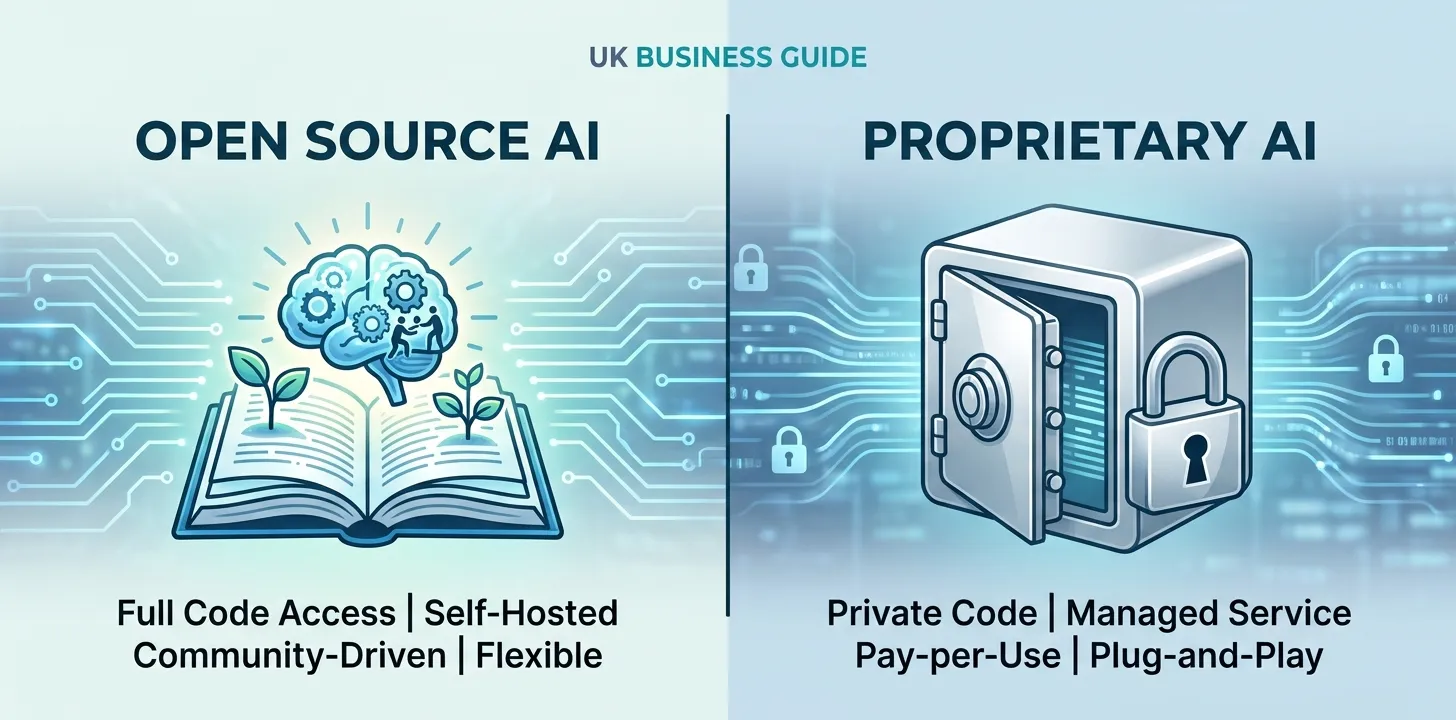
Open source AI models give you full access to their hidden code and inner mechanics. Anyone can download them, change them, and run them on their own computers for free. Popular open-source options include Llama by Meta and Mistral. Proprietary AI models are closed systems. A single private company owns the code, and you pay to use it over the internet. Examples include ChatGPT by OpenAI and Claude by Anthropic.
Think of open source like buying a house. You own the whole building. You can repaint the walls, change the locks, or build an extension. Proprietary AI is like renting a flat in a nice building. You get great rooms and quick repairs from the landlord, but you cannot change the walls or see how the pipes work.
If you want to read more about setting up your own computer systems, check out our related guide on basic server hardware for UK small businesses.
- Open Source: Free to download, fully customizable, runs on your own hardware.
- Proprietary: Paid service, locked code, managed entirely by the maker.
Costs and Setup Needs
Proprietary models are very cheap to start using. You do not need expensive computer parts. You just pay a small monthly fee or a tiny price every time you use the tool. However, as your business grows and uses the AI thousands of times a day, those small fees add up fast.
Open-source models do not cost anything to download. But running them takes powerful computers with special processing chips called GPUs. Buying or renting these fast servers in the UK costs a lot of money upfront. You also need to pay skilled staff to manage the software and keep it running smoothly.
Last year, I helped a small accounting firm in Leeds pick an AI system. They started with a paid proprietary model because it cost just £20 a month. Once they grew to fifty staff members, the monthly bill jumped to thousands of pounds. We switched them to an open-source model running on their own local server. The upfront cost was high, but it saved them over £12,000 in its first year.
- Proprietary Costs: Low start costs, higher ongoing fees as you grow.
- Open Source Costs: High setup costs for servers, zero software fees.
Data Privacy and Security
Data security is a huge concern for UK firms due to strict laws like the UK GDPR. Proprietary AI models require you to send your customer information over the internet to a third-party company. Even if the company promises to keep it safe, your data lives on their servers.
Open-source models offer complete privacy. You can install the AI on a computer in your office that is not even connected to the wider internet. Your customer records, financial figures, and private trade secrets never leave your physical building.
I once audited a law practice in London that handled confidential court cases. They could not use standard proprietary AI because sending client notes to an outside cloud server broke their client privacy rules. By setting up a offline open-source model on a private office server, they used AI to summarize lengthy legal documents without breaking any regulatory rules or data laws.
- Proprietary Privacy: Data leaves your office and travels to cloud servers.
- Open Source Privacy: Data stays safely inside your business network.
Customization and Performance
Proprietary AI models are usually the smartest tools on the market. Large tech companies spend hundreds of millions of pounds training them on massive datasets. They handle general tasks, like writing, coding, and language translation, extremely well right out of the box. However, you cannot train them on your unique business methods.
Open-source models might start out slightly less smart at general tasks, but you can alter them completely. You can train an open-source model using your own company manuals, past customer emails, and product catalogs. This process, called fine-tuning, makes the AI an expert in your specific niche.
For a deeper dive into adjusting models for special tasks, read our related guide on how to fine-tune AI on custom company data.
- Proprietary: Very smart out of the box, but hard to change.
- Open Source: Easy to tweak and train for your exact business field.
Frequently Asked Questions
Get quick, clear answers to the top questions UK business owners ask on Google about choosing between open source and proprietary AI systems.
Which AI model type is safer for UK GDPR rules?
Open-source models are safer for UK GDPR rules. You run them on your own private servers, so sensitive customer data never leaves your control or goes to outside companies.
Are open-source AI models completely free to use?
The software code is free to download. However, you must pay for powerful computer hardware, electricity, server storage, and IT staff to set up and run the model correctly.
Which AI model type is better for small budgets?
Proprietary models are better for small upfront budgets. You pay a small monthly subscription instead of buying thousands of pounds worth of specialized computer servers to get started today.
Conclusion
Choosing between open source and proprietary AI comes down to your budget, technical skill, and privacy needs. Proprietary models offer instant access to top-tier intelligence with zero setup hassle. They work best for small teams with limited tech skills. Open-source models give you full privacy, zero subscription fees, and total freedom. They work best for growing companies that handle sensitive data or want custom tools. My top expert tip is to start with a proprietary tool like ChatGPT to test your ideas quickly. Once you know exactly what tasks you want AI to handle daily, calculate the cost of moving those tasks to a self-hosted open-source model. Your clear next step is to list the types of data your business handles. If that data is private, start testing open-source options on a local machine today.