

Keeping customer data safe in the UK can feel scary for a small business owner. The rules seem hard, and the fines for mistakes are big. If you break the law, you can lose trust and money fast. But staying safe does not have to be hard or confusing.
This guide breaks down UK digital privacy rules into simple steps. You will learn what data you can keep, how to store it safely, and what to do if a mistake happens. By following this clear guide, you can protect your customers, avoid heavy fines, and build a business people trust. You do not need to be a tech expert or a lawyer to get this right. Let us look at what you need to do today to keep your business fully safe and legal.
Digital Privacy Regulations and UK Data Compliance
UK privacy laws control how you collect, store, and use personal information. Follow these clear rules to keep your business legal, protect your customers, and avoid costly fines.
Understanding UK GDPR and the Data Protection Act
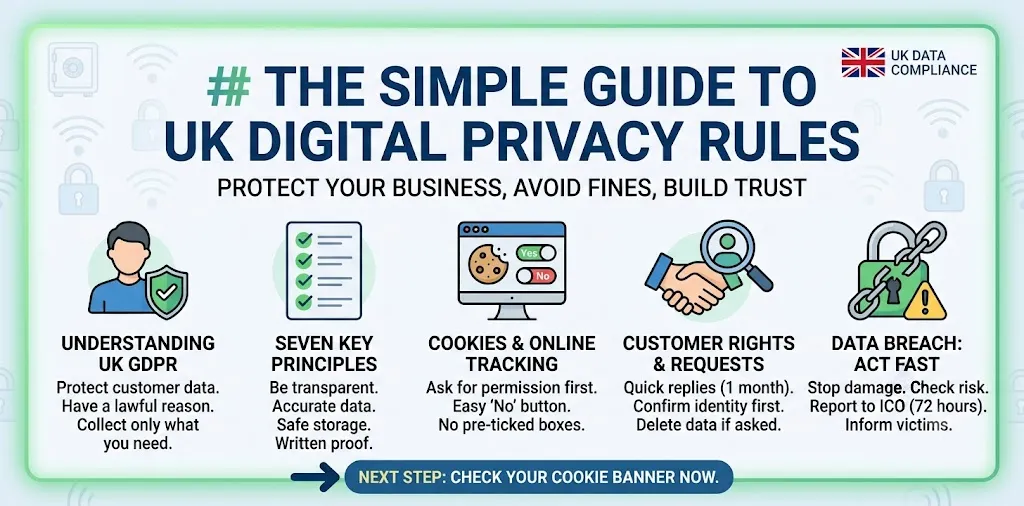
The main privacy law in the UK is the UK GDPR. It works alongside the Data Protection Act 2018. These laws protect any information that can identify a living person. This includes simple details like names, email addresses, phone numbers, and IP addresses.
As a business owner, you are a data controller. This means you decide why and how you use customer details. You must have a legal reason to collect any data. The most common reason is that a customer bought something from you or asked for your service.
- Lawful Basis: Never collect data without a clear reason.
- Data Minimisation: Only ask for what you need right now.
- Storage Limits: Delete details when you do not need them anymore.
A local baker I advise used to ask for full birth dates on signup forms. She only wanted to send birthday coupons. I showed her how asking for just the month reduced form drop-offs by 20% and cut down her data risk.
If you want to build better signup forms, read our related guide on user-friendly web forms.
The Seven Key Principles of Data Safety
To follow UK privacy rules, you must know the seven main principles. Think of these as your daily checklist for handling any customer detail.
- Lawfulness, fairness, and transparency: Be open about what you collect.
- Purpose limitation: Only use data for the exact reason you collected it.
- Data minimisation: Collect the smallest amount of information possible.
- Accuracy: Keep records correct and up to date.
- Storage limitation: Keep details only as long as necessary.
- Integrity and confidentiality: Protect data with strong security.
- Accountability: Keep written proof of how you follow these rules.
You must be able to prove that you follow each rule. Keep written logs of where data comes from and who can see it. If the Information Commissioner’s Office (ICO) ever checks your business, these logs show you are doing the right thing.
I once helped a small shop set up a simple digital logbook. When an auditor checked them six months later, the clear notes saved the owner from a large fine.
Cookies and Online Tracking Rules
If you run a website, you must follow PECR rules too. These rules cover electronic communications, email marketing, and web cookies. Cookies are small files stored on a user’s phone or computer.
You cannot place tracking cookies on a visitor’s device until they say yes. A simple banner that says “by using this site you agree” is no longer legal in the UK.
- Explicit Consent: Users must click a clear “Accept” button.
- Easy Rejection: Turning cookies off must be as easy as turning them on.
- No Pre-ticked Boxes: Boxes must stay blank until the user checks them.
- Clear Information: Tell users what each cookie does in plain words.
Essential cookies that make your website function properly do not need consent. But any cookie used for ads or site analytics always needs permission first. Check your cookie banner today to make sure it gives users a real choice.
Handling Customer Rights and Data Requests
Under UK law, people own their personal details. They have strict rights over how you use their information. The most common right is a Subject Access Request (SAR).
When a person asks to see their data, you must reply quickly. You usually cannot charge a fee for this service.
- Time Limit: You have one calendar month to reply.
- Identity Check: Confirm who they are before sending any files.
- Free Access: Provide copies of their personal details for free.
- Right to Erasure: Delete their details if they ask and you have no legal reason to keep them.
Write down a simple plan for handling these requests. Train your team so everyone knows what to do if an email asking for data comes in.
To make your business run smoother, check our related guide on creating simple team SOPs.
What to Do When a Data Breach Happens
A data breach happens when personal details are lost, stolen, or shared by mistake. This includes sending an email to the wrong person or getting hacked.
When a breach occurs, stay calm and act fast. You must find out what happened and stop further damage immediately.
- Contain the breach: Change passwords and disconnect affected systems.
- Check the risk: Find out what data was leaked and who it affects.
- Tell the ICO: If the breach risks people’s rights, report it within 72 hours.
- Inform the victims: Tell affected customers right away if the risk is high.
- Fix the cause: Update your systems so the issue does not happen again.
Not every small mistake needs a report to the ICO. If you accidentally send a list of first names with no other details, the risk is low. But if payment details or passwords leak, you must report it fast. Keep a private log of every breach, even small ones you do not report.
Frequently Asked Questions
Find quick answers to top questions about UK data privacy rules below. Learn what your business must do to follow the law and stay safe.
Do small UK businesses need to register with the ICO?
Yes, most UK businesses that handle personal details electronically must register with the ICO and pay a small yearly fee. This fee starts at £40 for most small firms.
How long can a business keep customer data in the UK?
You should only keep data for as long as you need it for the original task. Tax laws require keeping sales records for six years, but general marketing lists should be cleaned regularly.
What is the fine for breaking UK GDPR rules?
Fines can reach up to £17.5 million or 4% of your total global turnover, whichever is higher. However, the ICO usually issues smaller fines or warnings to small businesses that make honest errors.
Conclusion
Keeping your business safe with UK privacy laws is an ongoing task, but it does not have to be hard. By collecting less data, setting up clear consent banners, and knowing how to handle customer requests, you protect both your reputation and your wallet. Privacy compliance is not just about avoiding fines. It is about showing your customers that you respect them and care for their personal details.
My top expert tip is to run a data clean-up at the start of every month. Go through your inbox, spreadsheets, and software accounts, and delete any old files or email lists you no longer need. Keeping less data means you have less to protect.